
Meet the Member: Chrissy Partheni, Curator of classical antiquities at National Museums Liverpool.

What classical collections are you involved with?
Although I trained as an archaeologist and the World Museum has important classical antiquities, my role is really diverse. This is because the collections are very broad: they range from the prehistoric Aegean cultures to Roman times and late antiquity material to 18,000 items coins as well as the Anglo-Saxon material from the Kent burials with fascinating objects such as the Kingston brooch.
What is your role in relation to them?
My role is to improve documentation about the collections and promote them on our website so that many more people can find out about what we have not only on display but also in our museum store. I am also involved in the curation of major exhibitions drawing from our collections such as the Beauty and Virtue we co-curated in Mexico in 2019, featuring the Roman collections and Henry Blundell, the 18th century collector from Sefton. I respond to public enquiries from all over the world with regards to our collections and facilitate research visits and study groups from universities, colleges and community heritage groups. I work in collaboration with various departments at National Museums Liverpool to advocate for the collections, ensure they feature regularly in relevant marketing campaigns and on the social media and to improve learning and participation resources.
What are you working on at the moment? (or when COVID permits)
I have been working closely with our exhibitions department over the last two years to develop a major exhibition on Gods and myths of Ancient Greece and Rome (the provisional title of the exhibition, scheduled for the winter of 2023). We want to showcase our important Roman sculptural collections, statues of gods and goddesses, portraits and sarcophagi reliefs as well pottery and other collections in a new and exciting way that will appeal to our audiences and enthuse them about the different tales and myths from antiquity. We will use digital media to enhance the impact of the collections in a creative way. I have always enjoyed the diversity of National Museums Liverpool collections and it has been exciting that we can also draw from the Walker Art Gallery’s drawings and paintings for certain myths and stories. It fascinates me by how ancient stories are retold and revisited throughout centuries and even find their way into modern life.
I enjoy working in partnership with other institutions and recently I supported the development of online resources for the AHRC funded, King’s College project, Improving access to classical studies for museums and schools. I am really pleased we solely relied on examples from World Museum’s collections to inspire students and teachers.
What are your priorities for finding out more about the collections?
Many of the classical collections came from Joseph Mayer’s collections and there is little archival resources. We tend to know little about how he collected material during his travels. We rely heavily on comparisons with similar collections to precisely date and interpret some of these collections. Further research into Joseph Mayer’s networks or relevant auction catalogues is an ongoing project. My priorities overall are to improve our online collections and include much more material from Ancient Greece and Rome as well as our numismatics collections. Connecting to researchers across the world is essential to promoting further the collections.
What is your favourite object, and why?
I am not that comfortable with the notion of a curator’s favourite object. I believe in the public ownership of the collections and I am more interested to find out what the public views as interesting objects from our collections. Every object has a tale to tell. The craftmanship of many ancient objects and the appeal of their design is often extraordinary.

Similarly, I appreciate fragments or objects that bear the marks of use or had their use changed. The mysteries of certain objects, we sometimes as curators cannot resolve is a strong motivation in my role.
An example is the Greek inscription carved in stone from Cyzicus (modern Turkey), from 3rd century AD, 14.1.90.7.
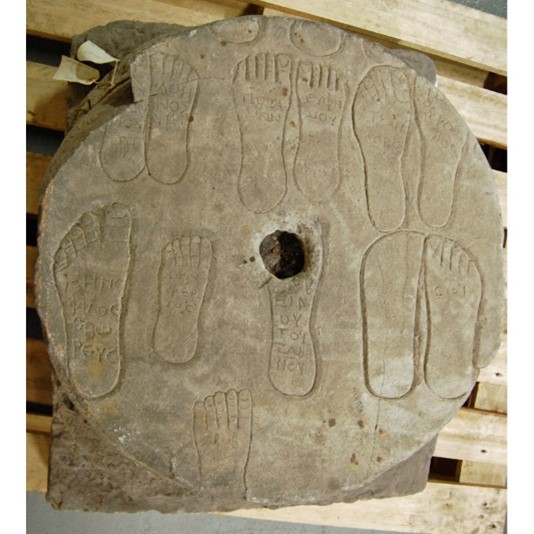
The inscription it may be from a gymnasium or a sanctuary. On the stone there carved pairs of feet with names of different people: the devotees of the relief or the winners of an athletic competition? The inscription was at some point cut out and re-used as a different object, perhaps a pillar and that is why it has a whole in the middle.
What would you like to happen with the collections in the future?
Following the exhibition in 2023, I would hope that we can develop a permanent gallery for the classical collections at World Museum; perhaps a display that is less about Greece or Rome as the main geographical or chronological focus and more about the networks across the Mediterranean world. I want more people to get to know the ancient collections of World Museum Liverpool, visit them and continue to explore them.
Where can we find out more?
You can browse on the different categories and view digital records of the antiquities collections on https://www.liverpoolmuseums.org.uk/collections/antiquities
There are also various stories or videos published on different items of the collections under stories feature of the website:
https://www.liverpoolmuseums.org.uk/stories/hidden-history-of-aegean-boatbuilding
https://www.liverpoolmuseums.org.uk/stories/spotlight-roman-sculpture
https://www.liverpoolmuseums.org.uk/stories/piecing-together-excavation
Zoom in and click on a marker to find out more about the UK’s classical collections.
 Classical Collections Network