
What classical collections are you involved with?
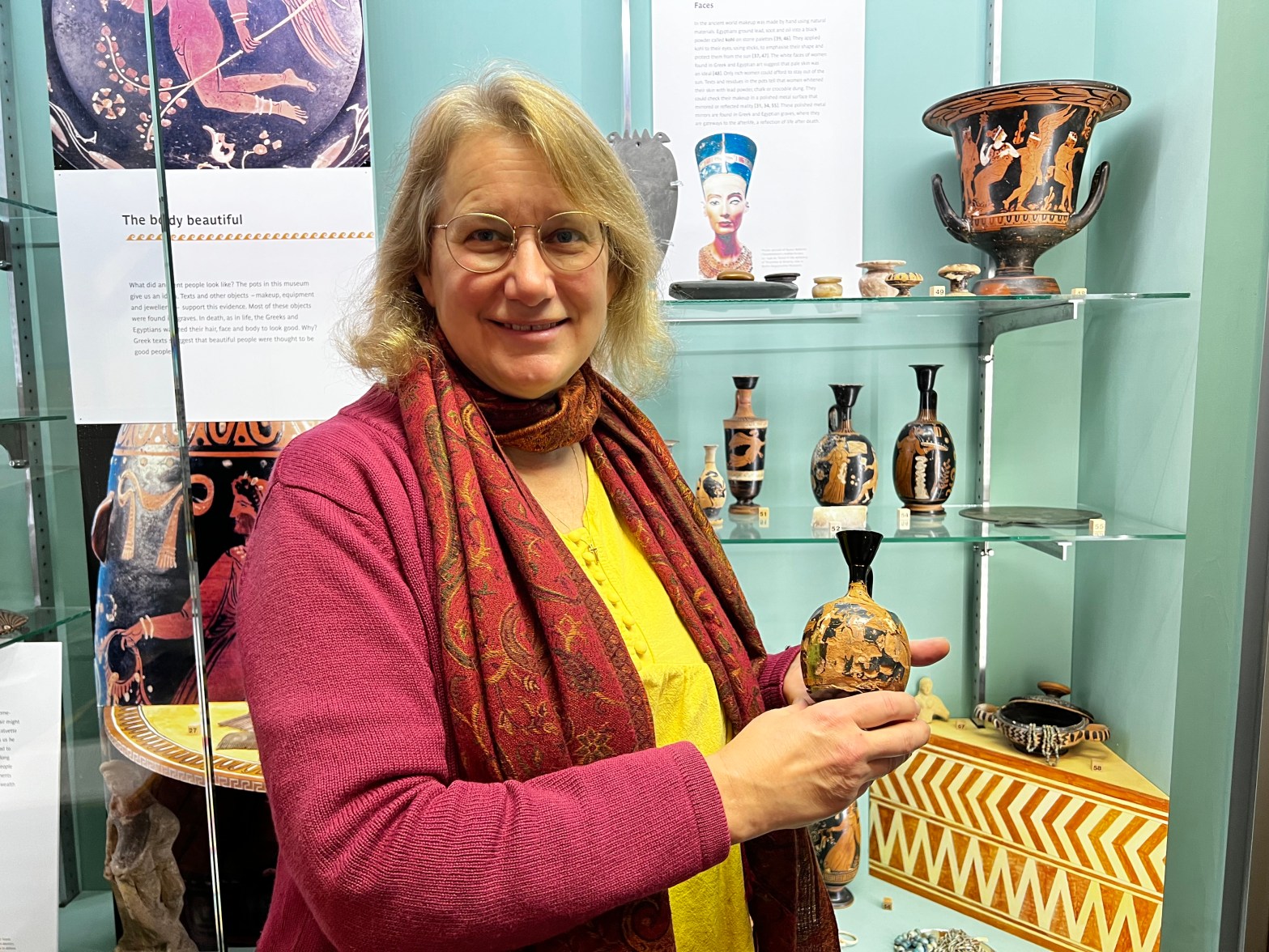
I’m involved with lots of collections, but I’m Curator of the Ure Museum of Greek Archaeology in the Department of Classics at University of Reading. I’m also full-time Professor of Classical Archaeology. Yes, full-time meaning I do a full teaching load, and the curatorship is just one of those many administrative tasks one does alongside their teaching. So when I got the teaching/research lectureship they said ‘oh, and you get to be our curator too’.
What are you working on at the moment?
Pots, pots, pots, festivals, calendars, Aphrodite, & Herakles!
In particular, I’m working on two books. One is called Master of Attic Red-figure Painting and is under contract with Bloomsbury. The other will be called Immanence and Innovation: Festival Ware for Athenian Women, and is co-authored with Katerina Volioti. It is under contract with University of Wisconsin Press. I’m also working on a sprinkling of articles on the other stuff.
What are your priorities for finding out more about the collections?
There’s lots of information about the history of the Ure Museum’s collection – collectors, donors, etc. – that hasn’t been properly explored or published. Because the Ures, after whom the Museum is named, excavated in Boeotia, our archives are useful for learning more about 20th c. archaeology in Boeotia. Also, we realised how much more is in the archives about the origins of the University, its museum, some friends and colleagues of the Ures, international scholars, and especially their Greek friends. Because of the quick changes to pretty much everything in Greece during the Ure’s working lives—language, calendars, politics, etc—we have some really important information relating to the foundation of the modern Greek state too. When she served as Research Officer of the Ure Museum, between 2018–2020, Amara Thornton did some amazing work sifting through these archives, preparing exhibitions on Hidden Women, Allen Seaby, and otherwise getting the word out about the collections histories. In fact she rewrote the history of the Ure Museum, which she realised began as a Museum of History and Archaeology but narrowed to Greek (and Egyptian) because of material that was moved to the History and later Archaeology Departments.
What is your favourite object, and why?
My favourite in our collection is our squat lekythos by the Makaria Painter, decorated with Aphrodite and the ‘virtues’ e.g. Makaria (‘Blessedness’) because that’s the reason I first visited the Ure Museum, while I was a PhD student. It’s in my dissertation & subsequent book, Polis & Personification (Brill 2011). It brought me to Aphrodite, and of course it has personifications!
What would you like to happen with the collections in the future?
Our main hope is that it continues to be a department museum, in a Classics Department where it can best support students and researchers, within and beyond the department. To that end, I would love to link our archives to the Ure Museum database. We’ve been wanting to do this for decades, and in fact our existing database was completely created through the hard work of volunteers, as there was never a funding stream for digitization per se! So we’ve done a lot of work digitising & organising, as well as studying our archives over the years, and we just need to take that last step, getting an integrated system that shares it all on the web.
Where can we find out more?
The database & particularly the Makaria Painter’s pot
The Ure Museum’s first curator, Annie Ure
My publications.
 Classical Collections Network